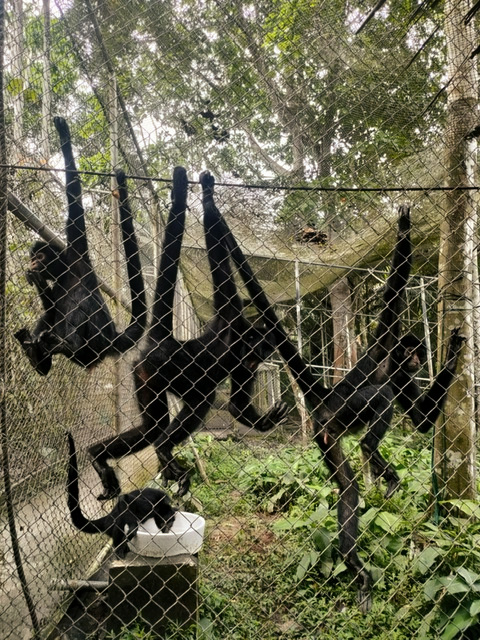
Some of the individuals in care at Pilpintuwasi, due to their past experiences they have not been permitted to be released. We hope ADI takes initiative to find larger facilities and potential release sites.
Spider-monkeys, one of the largest primates in the Americas and a frequent sight seen across growing “exotic pet trends” and entertainment. These highly intelligent and social creatures are often found in troops of up to 30 individuals, however, there has been groups recorded with having over 100 members in the wild.
The spider monkey has very long, thin arms with no opposable thumb – instead a hooklike hand that allows them to swing through the trees. The long limbs, with the occurrence of walking on two legs and common behaviour of hugging one another. Embracing each other and wrapping themselves around others makes them seem “cute” and “cuddly” – these desired traits are idolised for those wanting exotic pets.
Unfortunately, spider monkeys are under threat from hunting and trapping – these wild animals are not pets. nor will they make good pets, they need stimulation – large groups and social connections- a huge territory and canopy to browse for fruits. They are not here for our entertainment and suffer in captivity.
During the days, these monkeys search for fruit which is the main part of their diet. While they also observed eating sees, flowers, barks, leaves, and small insects during the dry season when the fruit is not always available. These omnivores are incredibly intelligent, recognizing seasonal differences in the forests that they call home – having robust memories of where to find fruits and paths through the canopy.
The name Spider-monkey comes from the similarities they share with the arachnids when they drop from trees, upside and hang from their tails with arms and legs dangling – resembling a sort of spider shape. Their genus name is Atelese – the origin meaning “imperfect” which refers to the fact they do not have opposable thumbs.
There are seven species of spider monkeys, which are wild populations are largely concentrated in Brazil, Columbia, Venezuela, Ecuador, and Peru. The individuals that ate refuge at Pilpintuwasi are all victims of the illegal wildlife trade. Several of the spider monkeys were tied with short metal chains to the floor of a garage in Lima, immobile and used as entertainment as pets. The troop we have were rescued by Animal Defenders International (ADI) which works with varying animal welfare cases and conservation practices. They were brought to our center where they are now cared for by Nils, they have just one worker dedicated to their care – they have been traumatized and it is paramount we do not stress them further.
One spider-monkey in our care is easily distinguished from the others, we gave her the name Valeria as she bared the eyes of the ‘white walkers’ seen in the popular TV show ‘Game of Thrones’. Her eyes are a breathtaking pale blue, this is a very rare phenotype seen in primates, in fact only three species in the world display this trait – humans being one, spider monkeys, and one species of lemur. Valeria is a brown-spider monkey, one of the most endangered primates in the Neotropics, and has been listed six times on the ‘World’s 25 Most Endangered Primates” list. This unusual eye color can be seen in less than 13% of the wild spider monkey population found in Columbia, the blue-iris mutation, unfortunately, makes them more desirable to hunting – a rare mutation that could be a death sentence due to the human greed and desire to collect natures treasures.